

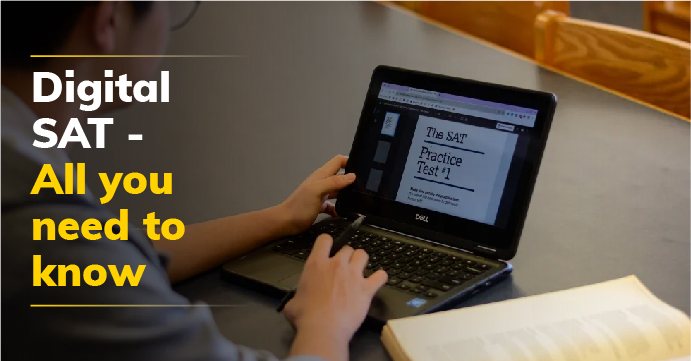
Collegeboard’s momentous shift from physical to digital has caused some confusion among folks who’ve been preparing for the SAT or PSAT in the older format. However, in the context of an ever-digitizing world, this is a move that is not only tech-savvy but also necessary. Yes, the new format is unfamiliar, but as educators in the field of test prep, it’s our responsibility to familiarize you with what we do know. Here’s the latest information on the Digital SAT.
Previously, the SAT was a pen-and-paper examination designed to test the language and mathematical skills of applicants aspiring for undergraduate courses abroad. The verbal section was used to gauge students’ ability in decoding how evidence is used to support a claim or the importance of vocabulary in certain contexts. Similarly, the math section tested candidates’ aptitude in specific topics such as algebra, data analysis, geometry, trigonometry, complex numbers, etc.
The current digital SAT is set to launch in March 2023. Although the names of the sections have been altered (1. Reading and Writing and 2. Math), they will continue to measure largely similar knowledge and skills including the use of reading/writing passages across a range of academic disciplines, demonstrations of command of evidence, both textual and quantitative, emphasis on high-utility words and phrases in context along with a continued focus on math that matters most for college and career readiness.
Here’s what has changed:
Duration
The Digital SAT is much shorter—lasting 2 hours and 14 minutes (64 minutes for Reading and Writing and 70 minutes for Math) instead of 3 hours. This means that the test-takers have more time, on average, to answer each question. We can safely conclude that the digital SAT Suite is shifting its focus toward students’ skills and knowledge, not test-taking speed.
Sectional changes
The verbal section, which previously contained two sections—Reading and Writing & Language, has now been condensed into one Reading and Writing section. Rather than a few long texts with a wider range of subjects, we now have shorter passages with a single (discrete) question associated with each passage or passage pair. The questions themselves have been divided into four broad sections—Craft & Structure, Information & Ideas, Standard English Conventions, and Expression of Ideas.
In the quantitative aptitude section, the range of topics covered has been expanded. But, a welcome change is that calculators are allowed throughout the math section. Moreover, the average length of in-context questions —commonly referred to as “word problems”—has been reduced. Broadly, the math section has been segregated into Algebra, Advanced Math, Problem-solving & Data Analysis, and Trigonometry & Geometry.