If you’re having a tough time choosing between a general business major and a finance major, your struggle is understandable. The career fields of business and finance are so closely connected that the US Bureau of Labor Statistics (BLS) categorizes the jobs within them as a single occupational group. With such a large overlap when it comes to college curricula and career prospects, these two degree programs can be difficult to differentiate. Both these degrees provide the transferable skills and expertise needed in these industries, but how are you meant to tell which degree option is right for your specific needs? To make that decision easier, here’s a closer look at what to expect from these two distinct degrees.
What is the difference between a Business and Finance Degree?
A business degree helps students acquire general business skills that can help them obtain management or marketing roles in the corporate sector and generally cover subjects that can be employed in regular business areas such as accounting, finance, and management. While students pursuing a general business degree will take finance courses, they don’t focus on the subject specifically. Instead, they devote their time to a balanced blend of studies in business law, marketing, operations management, organizational behavior, and other subjects.
Degrees in finance, on the other hand, are a lot more specialized and explore the nuts and bolts of financial institutions including credit unions, investment firms, banks, insurance companies, and brokerages. Finance provides the technical and analytical skills necessary to understand how financial markets function, and how businesses operate and make decisions within these markets. This concentration will help prepare you to enter the finance industry – whether in financial institutions and divisions or in government or non-profit institutions.
There is some overlap between the two degrees, particularly in the first couple of semesters, when business and finance students are both likely to spend some time learning about accounting, statistics, economics, and business law and pick up hard skills along the way. However, as they make their way through their syllabus, business management students branch out into areas such as organizational behavior or human resources, while finance students continue to delve deeper into global finance, risk governance, and other topics. Applicants to finance bachelor's degree programs need to have strong mathematics skills, so taking any available advanced courses in algebra and calculus is advisable.
Different Majors In Finance
Finance majors may also get to pursue a specialization, but those specializations are often narrower than one would typically find in a business administration degree program. Specialization options for bachelor’s in finance students might include wealth management, investments, real estate, or preparation for a Master of Science in Finance degree.
Let’s explore the different kinds of finance majors and degrees.
Business And Finance
Much of the coursework in a business finance bachelor's program is interdisciplinary, covering topics in economics, mathematics, and the social sciences. Within the major, students obtain
a deeper understanding of the modern global business environment and its economic structure, disciplinary skills in economics and statistics, and a focused introduction to core modules such as accounting, finance, marketing, operations, and organizational management.
Classes cover the financial history and theories, as well as the practical skills needed to manage business assets. The Business & Finance major helps students develop knowledge and skills in corporate finance, investment management, securities trading, financial markets, and more. Finance electives such as Futures and Options, Private Equity, Debt Instruments, etc. deepen the knowledge of the workings of financial markets.
International Business And Finance
The importance of international business is greater than ever as companies around the world become better connected. That coupled with a specialization in finance makes for a powerful combination. The increasing globalization and internationalization within trade and industry have led to a growing demand for managers with an international perspective as well as the ability to evaluate the economic consequences of their decisions. This degree not only provides you with the professional qualifications for making strategic decisions concerning difficult and complex financial matters but also gives you experiences and competences in terms of acting in an international context.
International Business & Finance degree holders are equipped with specialized skills that require them to deal with high-quality products, services, and large capital investment, as compared to traditional business graduates.
Finance And Economics
This combination is generally offered at the graduate level and is meant for students who have had a solid background in Math, Economics, or Finance at the Bachelors’ level. This is a course of study covering economic theory, calculus, accounting, finance, and laws & regulations. It is aimed at students who are interested in gaining a deep understanding of the theory and practice of financial markets. The rigour of a Finance and Economics program is recognized across the world and it also provides an excellent grounding for students who are interested in progressing to a Ph.D. in finance or in economics.
The benefits of obtaining an MSc in Finance and Economics are myriad. Prospective employers are attracted to applicants who choose this type of challenging and practical coursework. You gain the skills to work as a portfolio manager, risk management consultant, or financial analyst.
Let’s have a look at the differences in the core modules of these variants of a Finance degree.
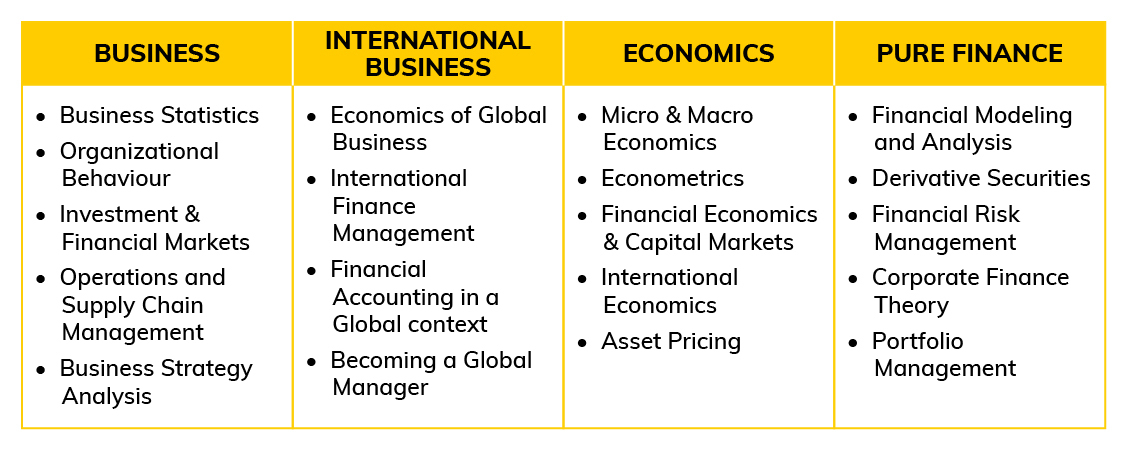
Is specialization a good thing or a bad thing when it comes to finding a job?
If your education is too broad, employers might feel that you don’t have enough depth in a complex subject area like finance to add value to their organization. If you have a business administration degree but are applying for a job that requires expertise in finance, your prospective employer may feel that you would need far more on-the-job training than the company is willing to provide.
This reality certainly doesn’t mean that neither degree will get you a job, but instead, that neither major is intrinsically a better choice than the other. That said, although both of these scenarios certainly exist, studies have found that finance and other math-focused business majors have more benefits. General business majors have a greater chance of unemployment or underemployment as well as lower salaries than their peers who majored in finance.
Finance Job Roles
The role of people trained in finance is expanding rapidly within the business world. Changes in the financial scene—rising securities prices, fluctuating inflation, currency values, and interest rates, and globalization of markets—have created an awareness that financial knowledge is essential to the effective management of business firms and many other types of organizations.
As per US BLS, finance jobs are expected to grow by 10 percent over the next decade. Hence, a finance degree would be advantageous in areas like corporate financing, commercial banking, money managing, investment banking, and financial planning. Possible job roles could include:
- Financial Analyst (average salary of $68,343)
- Personal Financial Advisor (average salary of $69,869)
- Financial Manager (average salary of $79,606)
Even if you eventually decide to take your expertise elsewhere, you’ll have gained a unique set of skills including negotiation, numeracy, pitching, teamwork, and networking, skills highly valued by employers in many other sectors.