
What's your major? Around the world, this time-honored question of undergraduates is increasingly drawing the same answer: economics.
Collegify
Collegify
Academics
A series exploring the differences between similar majors.
 By Rohan Ganeriwala5 min read
What's your major? Around the world, this time-honored question of undergraduates is increasingly drawing the same answer: economics.
From the Journal
Academics
Purdue’s 2026 AI working-competency requirement is discipline-specific, not a generic prompt-writing course. It offers a useful test for families: does a university teach access to AI, or the judgment to verify and defend AI-assisted work?
Academics
Choosing high school subjects is important but not irreversible. Math isn't essential for all careers, but keeping it helps in business and STEM. Chemistry is crucial for traditional engineering but less so for AI or coding. Fine arts has strong career prospects, especially with tech integration. Em
Academics
Related Collegify pages
Plan your master's application with postgraduate guidance.
Connect your interests, school choices, and long-term direction.
Explore guidance for undergraduate college applications.
See how Collegify supports students through admissions decisions.
Economics is the study of the ways in which society allocates its scarce resources among alternative uses and the consequences of these decisions. The areas of inquiry deal with a varied range of topics such as international trade, domestic and international financial systems, labor market analysis, and the study of less developed economies. The economics major enables students to analyze social issues. Besides laying the groundwork for careers in economics, the economics major can prepare students for careers in law, business, public service, and other related fields.
One option that is becoming more popular is combining economics with another subject. It is after all rewarding from a career perspective to bring together studies of market forces with a more academic and theoretical social science.
Successfully completing and benefiting from a degree in economics require you to have an analytical mindset and the willingness and focus to appreciate a wide range of arguments and discourses. A degree in economics will also require superior writing skills and a head for figures.
Economics is fundamentally a technical subject involving math and stats. Before specializing or diversifying, students must prove their competency across a range of core modules that train them on essential skills.
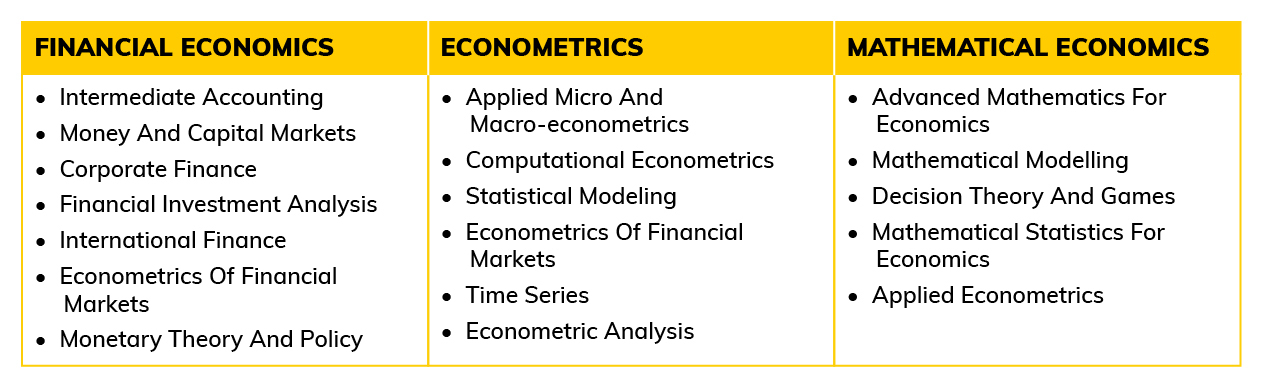
Traditional economics focuses on exchanges in which money is only one of the items traded. In contrast, financial economics brings under its purview exchanges in which money of one type or another is likely to appear on both sides of a trade. This major provides students with an academic framework wherein they can examine the role of financial markets and intermediaries in the allocation (and misallocation) of capital. Students who are drawn to abstract economics analysis and applied financial analysis will be a good fit for this major. This major equips you with the tools necessary to understand the nuances of financial markets and financial data analysis.
From financial markets to various financial intermediaries, from asset valuation and portfolio allocation to corporate governance - financial economics covers a wide range of areas.
Econometrics is a STEM-eligible program and acquaints students with the analytical toolkit of the modern professional economist, which includes coding, statistical methods, and advanced mathematics. It focuses on the application of mathematical and statistical techniques to the analysis of social, financial, business and economic data, which is available in ever-increasing quantity and complexity. The Econometrics major provides training crucial to these areas of high demand and greatly increases employment prospects for graduates.
Topics in Econometrics include GMM estimators, panel data, limited dependent variable models, ARCH and GARCH models, structural change and time series.
The Mathematical Economics major will appeal to students who have a strong interest in both mathematics and economics. In comparison to traditional economics, the Mathematical Economics Major focuses on preparing students for academic research in economics. Mathematics courses constitute roughly half of the courses in this major.
As we move on to comparing the core modules which essentially differentiate these Economics majors, it is important to note that introductory courses on the principles of Microeconomics and Macroeconomics, Mathematics and Statistics run common through all the majors.
FAME subjects – finance, accountancy, management and economics – are hugely popular among students. These subjects largely deal with money. They are also likely to make you the most after you graduate.
An Economics degree opens up multiple career paths and offers the greatest opportunity in terms of employability as well as pay packages. Some popular fields for economics students are teaching and research, finance, banking, government departments, international organizations, industry, and most types of enterprise, big or small.
Some popular job profiles are: -
Graduates with a Bachelor in Economics made an average annual salary of $70,000 while masters students made an average annual salary of $80,000. Graduates with a Ph.D. in Economics made an average salary of $101,000, as per data collected in 2019. Keep in mind that salary can vary greatly based on a number of factors, including job title, employer, and years of experience.
Do you tend to follow national and international news closely? Are you passionate about the business and finance sectors? If you are, it might be worth your while to explore economics degrees. Undergraduate economics degrees are available both as a Bachelor of Arts (BA) or a Bachelor of Science (BSc), based on the subjects you choose to study alongside.
The fierce competition for Ivy League admissions causes stress and financial strain. In today's job market, skills, real-world experience, and personal growth outweigh prestigious degrees. Parents should focus on holistic development and alternative pathways to help children build meaningful, succes