Philosophy, Politics and Economics do not truly belong together. Yet, that trio together sets students up for success and, hence, is increasingly gaining popularity as an undergraduate degree. In this article, we are not only going to explore the challenging, yet interesting, PPE degree, but also see how it is different from a straightforward Political Science, International Relations or an Economics degree.
What is PPE?
PPE has a curriculum which includes core and elective subjects from all three social sciences – Philosophy or Ethics, Political Science and Economics. However, you cannot say that a PPE major is just three minors stuck together. It also includes synthetic courses which combine all three disciplines and each course is taught in a way to complement each other’s conceptual understanding, giving it a unique and interdisciplinary approach.
PPE gives a student the ability to look at world affairs through different disciplinary lenses so that they better understand how political and economic systems shape human welfare. A good PPE student will be able to use economic tools to arrive at an optimum solution for an issue which has social as well as legal implications. For example, let’s take the issue of exchanging money for sex or human organs. A student will understand that the demand for these ‘goods’ are highly inelastic (Economics), analyze the legal policies governing these actions (politics) and use moral theories and ethical preferences (Philosophy) to devise a collective action for this problem.
Purdue’s 2026 AI working-competency requirement is discipline-specific, not a generic prompt-writing course. It offers a useful test for families: does a university teach access to AI, or the judgment to verify and defend AI-assisted work?
Choosing high school subjects is important but not irreversible. Math isn't essential for all careers, but keeping it helps in business and STEM. Chemistry is crucial for traditional engineering but less so for AI or coding. Fine arts has strong career prospects, especially with tech integration. Em
On the one hand, you have a broad range of subjects but they are at the same time focused and connected. So, it’s particularly rewarding to look at those three subjects together. The course begins with some general concepts- poverty, growth, equality, efficiency- but most of the course focuses on specific issues that are of concern today. PPE core classes study human values, cultural institutions, and economics in order to develop dexterous solutions to pressing social problems.
In PPE, you have the analytical side of economics but then also the critical thinking and communication skills you can derive from political studies and philosophy. Most problems we see today are actually multi-dimensional and so the fact that it is interdisciplinary gives students these skills to draw upon to deal with today’s real problems - How should we live together? How should we tackle the problems of inequality and gender discrimination?
These are all subjects from the social sciences and equip you to make an impact on society both at home and abroad. While we’ve seen how each of these subjects come together to complement each other in a PPE degree, let us now explore what would be different if you majored in these subjects (or their common counterparts) individually.
Political Science Vs International Relations
Both of these social science subjects encompass political systems and philosophies that have an impact on the functioning of the society, either directly or indirectly. What sets one apart from the other is the focus of the field. International Relations concerns the relations or foreign affairs of nations while Political Science deals with the political relations of states only.
Politics involves the collection and analysis of data to study political theories and gather information through surveys to examine different systems and ideologies, such as evaluating the consequences of laws and policies on government, businesses, and citizens. Students of political science are able to use historical data to forecast trends in politics, society, and the economy of a nation.
Politics is a subset of International Relations (IR). IR has a much wider scope as it also studies economic relations, cultural relations, military-technical cooperation, etc. between countries and citizens globally.
Pure Economics Vs PPE
As you can guess, a pure Economics degree is way more specialized than a PPE degree, making it tougher and a more rewarding course to pursue. A PPE student would gain a foundation of Economics through core courses like Microeconomics, Macroeconomics, Public Finance, etc. The Economics component in PPE is taught by the Economics Department faculty; it tends to focus on the economic history of nations and how economic tools can be used to assess and predict political outcomes. It is more essay-based and less mathematically and theoretically challenging than a pure economics course. However, most PPE degrees give you the freedom to specialize in one of the components after the freshman year. So, PPE is a great bet for someone who thrives in the diversity of Humanities but wants to explore the subjects before choosing a specialization.
If you want to know more about what a pure economics course and its variations entail, then refer to my earlier article on Majors Related To Economics.
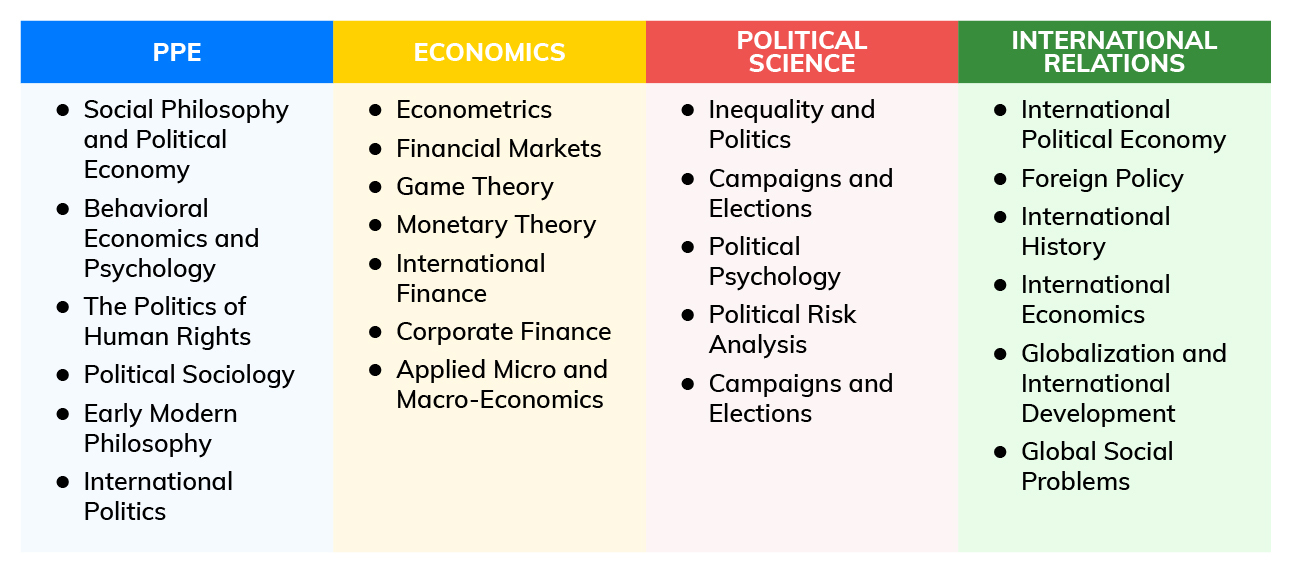
Also, to better understand how the focus of each major that we’ve discussed today differs from the other, let’s have a look at the popular electives under each major.
Career Prospects
It is important to bear in mind that PPE is a generalist’s degree. Yet, it is a foundation for a whole range of jobs that need the skills of being able to read, research, think, write and speak about complex issues that involve multiple dimensions. So, a student can either dive into a wide variety of careers that require analysis and good leadership or they can pursue a more specialized graduate study. Career roles for a PPE graduate could be:
Public Service
Journalism
Banking and Finance
Politics
Law
Government
Education
Academic research
Because PPE covers such a wide spectrum of careers, the average salary for jobs in this area is broad – roughly between $75,000 to $110,000. The more concentrated courses like political science fetch a median salary of $115,000, while the field of international relations has a much wider range - $82,000 to $115,000.
Whether future professionals are considering a degree in Politics, IR, Economics, or PPE, it is important that they understand the key differences in the disciplines and how differently they impact policy-making and societal issues. A firm understanding of these differences can play a vital role in helping prospective students determine which degree is best aligned with their career goals.
The fierce competition for Ivy League admissions causes stress and financial strain. In today's job market, skills, real-world experience, and personal growth outweigh prestigious degrees. Parents should focus on holistic development and alternative pathways to help children build meaningful, succes