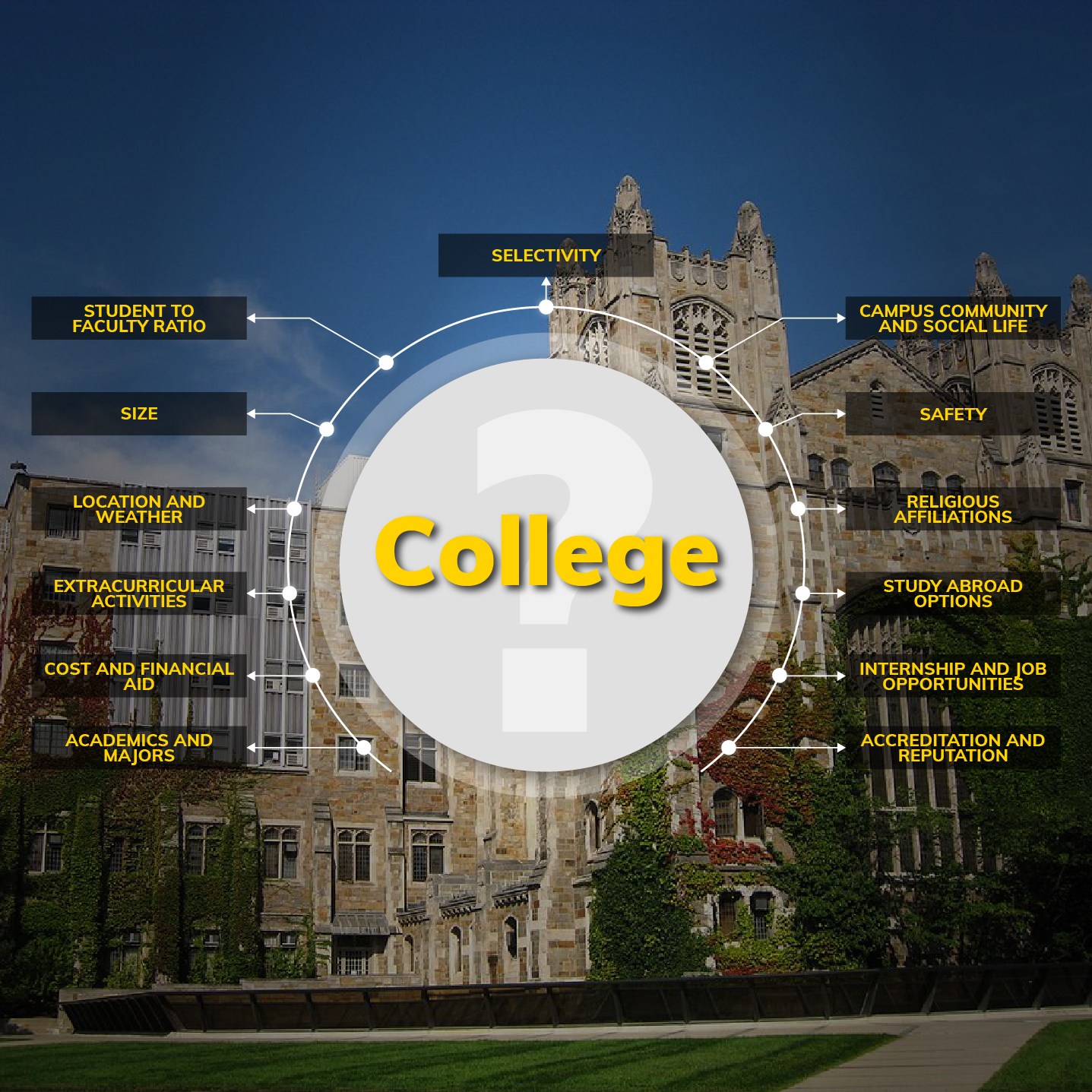
Why do students pick certain colleges? We’ve heard every reason imaginable – from being a fan of a Krispy Kreme donut shop on campus, to idolizing a particular professor in that institution. Depending on your personal priorities, these may or may not be good reasons to pick a college. And it's important to remember that what makes one school a student’s dream college may make it a nightmare choice for you. Nevertheless, there are some questions that we believe all students must answer while choosing the right college. The answers to these questions should then be matched to the student’s academic inclinations, facility requirements, personality type, location preferences, budget etc.
ACADEMICS AND MAJORS
Does the college have the major(s) I’m considering as well as several good backups in case I change my mind?
What is the academic reputation of the college? What about the reputation of my major(s) in particular?
What are the professors like? What are they known for, and what have they accomplished?
A waitlist is managed differently at every university. The practical priority is consistent: follow the institution’s exact update rules, but secure and act on an existing offer while the waitlist remains uncertain.
What are the academic facilities, libraries, and labs like?
What kind of research opportunities—not just in the sciences—exist on campus?
Does the school have an Honors College?
What is the credit requirement for Double Majors/Major and Minors?
Additionally, a pre-professional education prepares you for a specific job and includes areas such as engineering and pre-med. Some schools like MIT have very strong programs for those interested in the sciences but might not be right for someone interested in Literature. A Liberal Arts education, on the other hand, aims to equip you with general knowledge and reasoning skills suitable for many jobs.
COST AND FINANCIAL AID
What are the total costs for an international student?
Is the university need-blind or need-aware in its admission decisions?
What need-based and/or merit-based aid does the university have for international students?
What are the deadlines and processes for either merit or need-based aid?
Do you want to study in a Public or Private college?
Are there employment opportunities on campus for international students?
Must I maintain a minimum GPA or stay in my major to keep an award or scholarship?
Contact the Admissions Office and Office of Scholarships and Financial Aid to determine what you may qualify for. Do your homework and you may find that those higher sticker price colleges are actually much more in your financial reach than you realize. Also, when considering a college, make sure you’re aware of all the costs associated with attending the college, not just the cost of tuition. Other costs include: Textbooks, Housing, Fees, Food, Other Expenses.
EXTRACURRICULAR ACTIVITIES
Does the college offer what I’m looking for when I’m not in class?
What kinds of extracurricular opportunities exist on campus in art, music, theater, community service, athletics, etc.?
Are there clubs or pre-professional associations related to my major(s) or intended career?
Being involved on campus, putting yourself out there and meeting new people is a critical factor in getting adjusted quickly when you head off to college. To make certain the college you’re considering offers clubs and social activities you might actually be interested in, check their websites.
LOCATION AND WEATHER
Do I want to attend college in a rural, suburban, or urban area? Are you a city person who loves the hustle and bustle, or are you a small-town lover, who enjoys the simpler things and a quiet environment?
What is the weather typically like during the academic year?
What kinds of recreational opportunities and amenities are in the area? Are there things to do off-campus?
What is the transportation system for students around the area?
Can I live off campus? Or if I want to stay on campus, is housing available all four years?
The location of a college is a big factor that will impact your happiness, especially if you’re a warm-weather person but are stuck in freezing temps wearing five layers to keep warm. Also, take some time to consider how the college’s location will affect your education. Colleges in big cities and “party towns” tend to have a lot of distractions that may affect your academic performance. On the other hand, it may be difficult to find extracurricular off-campus activities if you’re located in a small rural town.
SIZE
Do you want to walk through the halls and always see familiar faces or walk out every day into a big crowd?
What is the overall average class size in the academic programs that interest me?
Do I learn best in larger lectures or do I prefer smaller discussion-based classes?
However, keep in mind that you can totally find your niche at any large university. And who cares if a small school doesn't offer a zillion academic and extracurricular offering as long as they have a handful that matter to you?
STUDENT TO FACULTY RATIO
What is the student-faculty ratio overall and in my potential major(s)?
Low student to faculty ratios are often ideal, but don't discount a school with a higher ratio. If teaching is the top priority at a college a 20 to 1 ratio might be better than that 10 to ratio at a big research-centered institution. The student-teacher ratio will vary by university. For example, at University of California-Berkeley, the average ratio is 17.8 to 1, while the ratio at Columbia University is 6 to 1.
SELECTIVITY
What is the average admitted student’s academic profile like, and how does it compare to mine?
Does the school take a holistic approach to admission decisions?
What are admission rates for students applying for Early Decision or Early Application vs Regular Decision?
Highly selective colleges get a lot of attention for their single-digit admit rates, but a vast majority of colleges and universities may accept well over 50% of their applicants, and they also offer high-quality academic and extracurricular experiences.
CAMPUS COMMUNITY AND SOCIAL LIFE
What is the social scene like on campus?
How do students spend their free time on campus and off?
What kinds of fun things are available to students through the school and in the community?
What kinds of people do I like spending time with or want to spend time with in college? Artsy? Athletic? Passionate about helping others? Studious? Social?
Think about if you are walking into a party school or a very conservative, education-focused school. Ideally, you want to surround yourself with like-minded individuals or people that you can learn from. So, if you are looking to study hard and focus, going to a party school might be distracting. Conversely, if you are looking to have the best four years of your life and you attend a stuffy private school, you may be disappointed.
SAFETY
Are there many incidents of crime? If so, how are they handled?
Does the college have its own police or security force?
Does the school have a safe escort and ride service for evenings and weekends?
Are emergency call boxes located throughout campus?
While many college campuses appear safe, appearances can be deceiving. Over the years, crime has increased everywhere, even on college campuses. Before attending any college, review their crime statistics and find out what safeguards they’ve put in place to ensure the safety of their students.
RELIGIOUS AFFILIATIONS
Is there an overall religious focus on campus?
Will I feel comfortable attending a school with a particular religious affiliation?
Are there places to celebrate my religious affiliation on campus?
If you’re not religious, you may want to think about the pros and cons of attending a school with a religious affiliation.
STUDY ABROAD OPTIONS
Are study abroad programs offered within my major?
How is study abroad funded?
How will study abroad affect the trajectory of my college career?
Studying abroad is a great way to see the world while gaining an education. If there are specific countries or programs you’d be interested in, find out whether or not the school has the options you’re looking for. Make sure a semester abroad won't negatively impact your projected graduation. If course credits don't transfer, a study abroad experience can make it difficult to graduate on time.
INTERNSHIP AND JOB OPPORTUNITIES
How will the school help me determine and achieve my career goals?
What is their postgraduate job placement rate like?
What does the career services office offer?
What kinds of experiential education opportunities, such as internships, co-ops, and volunteering exist on and around campus?
When thinking about which college to attend, think about your future job prospects, living situation, cost, and culture. Evaluating these things beforehand will ensure that your college experience is both memorable and rewarding.
ACCREDITATION AND REPUTATION
Is the college institutionally accredited?
Is my course or department institutionally accredited?
How does my course and/or college rank amongst others?
It may seem like accreditation has no importance to you as a student, but that could not be further from the truth. If an institution is unaccredited then students are not eligible for federal financial aid, credits are awarded for very little work and getting jobs is very tough.
To conclude, always remember that your future success is largely determined by you, not your college. College is what you make of it. It’s also important to define what the right college match for you is not. It’s not just the school with the lowest acceptance rate; it’s not the one with the “it costs more so it must be better” highest tuition. And it’s not just because it’s on one of those “best college” rankings list. Even if you've dreamed of going to a certain college your whole life, not checking out your other options is a mistake. Finding your perfect college match(es) takes time and effort, but it's worth it in the end.