
College Applications
Common App essay prompts 2026–27: choose the story before the performance
Common App essay prompts for 2026-27: choose meaningful material, protect the student's own voice and use a focused revision check before submission.
Collegify
College Applications
All about the admissions process for Medical Schools in UK.
From the Journal
College Applications
Common App essay prompts for 2026-27: choose meaningful material, protect the student's own voice and use a focused revision check before submission.
College Applications
A waitlist is managed differently at every university. The practical priority is consistent: follow the institution’s exact update rules, but secure and act on an existing offer while the waitlist remains uncertain.
College Applications
AI application rules differ at Harvard, Knight-Hennessy and Rhodes; Indian applicants can discuss permitted support and preparation with Collegify.
Related Collegify pages
Plan your US university journey with country-specific guidance.
Explore UK university options and application planning.
Explore course-led planning for Oxford and Cambridge applications.
Explore Canadian universities and admissions planning.
All students must firstly meet the academic requirements of each medical school to which they apply. Most students will have sat GCSE examinations in the years before applying and will sit A level examinations in the summer following their application. Most medical schools require applicants to be studying Chemistry and Biology at High School. Of course, Universities accept a range of academic exams in place of GCSEs or A levels, for example the Middle Year Programme and International Baccalaureate. More info on the accepted qualifications of international applicants are listed on each University’s website.
On top of academics, almost all UK medical schools require students to sit an entrance test. Most Universities require the UCAT, with a remaining 20% requiring a different test, the BMAT.
TMP are global leaders In UCAT and BMAT Prep. We support over 60% of the Top 100 Schools in the UK alone with this critical step. You can see more of our test prep services here.
For graduate applicants, those applying having already studied an undergraduate degree, some Universities may require the GAMSAT entrance test.
International applicants must also sit the International English Language Testing System (IELTS) to demonstrate proficiency in English. Most universities require an overall score of 7.0 or above.
The standard medical school degree in the UK is five years long. Most medical students are given the option to intercalate, where they will take an additional year of study to gain an additional Bachelors degree. This is often focused on developing research skills, with students able to choose from a range of subjects. At some medical schools, such as Oxford and Cambridge, this additional year is compulsory, making the medical degree six years.
Graduate courses, for those with a degree, are often accelerated, lasting four years.
Once graduated, students are provisionally registered as Doctors. This allows them to practise as a Doctor, but only under direct supervision. After one year in this role, Doctors are then granted full registration and can work without supervision.
Following the first two years working as a doctor, one may then apply to specialty training. The length of training depends on the specialty chosen, ranging from three years for General Practice, to over nine years for some Surgical Specialties.
Traditionally, medical schools have been given set quotas by the UK government on how many international students they can accept. Therefore, around 7.5% of places on medical school courses have usually been reserved for international students. This is currently under review and we anticipate this to change with the cap of only 7.5% of places for international students being removed.
Last year, there were 3530 international applicants to UK medical schools.
The ‘success rate’ of international students varies heavily depending on the medical school applied to. For example, around 1 in 9 international applicants to Imperial College London receive an offer, whereas 1 in 30 international applicants to Oxford receive an offer.
The Medic Portal offers Advice Consultations with our application experts who can advise on which medical schools to choose in order to ensure the highest chance of success. We also have a medical school comparison tool on our website, allowing you to compare information on every UK medical schools.
UK medical degrees are widely accepted within other countries, with popular destinations for graduates including Australia, New Zealand, Canada, UAE and Singapore. Each country will have their individual requirements, with some UK some countries allowing graduates to work immediately following graduation, and other countries requiring Doctors to have pursued specialty training first in the UK.
The USA recognises UK medical degrees, but graduates must complete the United States Medical Licencing Exam (USMLE) in order to practise.
India recognises all Specialty Training undertaken in the UK and recognises UK medical degrees from specific Universities. More information on the universities can be found here.
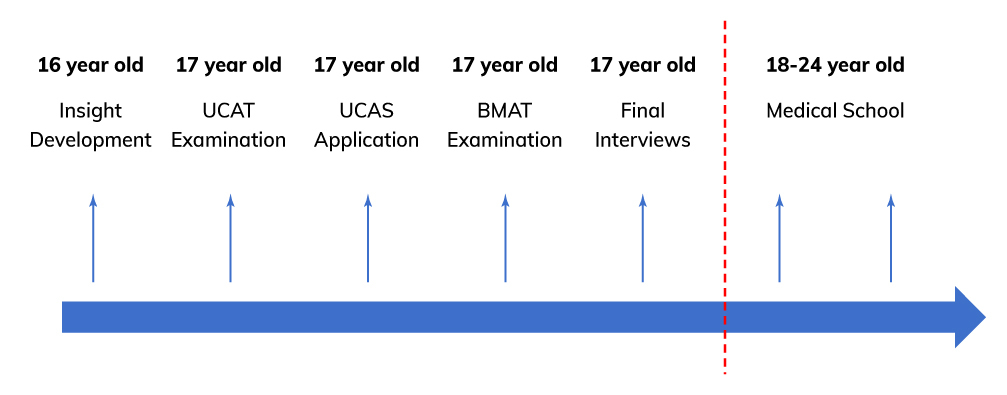
The diagram above provides a timeline of the typical application to UK medical schools.
All students must apply by October 15th in the year before they would start their degree, completing their application through a centralised application portal known as UCAS. Their application will include all academic qualifications to date, a personal statement, and the predicted grades for exams still to sit that academic year. Students can apply to up to four medical schools, but universities will not know the other medical schools a student has applied to.
Students must also sit the entrance tests required for the medical schools they’re applying to. For most this will be the UCAT, which students sit over the summer before they apply, with a range of dates to choose from. The BMAT can be taken around August, before the application deadline, or in November, after the deadline.
Following this, medical schools will invite a certain number of applicants to interview, based on academics, entrance test scores and personal statement. The best performing students at the interview will then receive an offer. If all exams have already been passed then this offer is unconditional, but if students have exams left to sit, their offer may then be ‘conditional’ on gaining the required grades later in that academic year.
The Medic Portal is dedicated to supporting students through each stage of their application. We provide courses and tuition on the UCAT, BMAT, Personal Statement and Interview, both in person and online.
All UK medical schools are considered credible institutions, as they must meet strict criteria of the General Medical Council in order to produce medical graduates.
Of course, some medical schools may generally be considered more ‘esteemed’ than others. This may be due to the reputation of the University itself, or the medical course. There are several league tables that attempt to rank UK medical schools. Rather than simply looking at a medical school’s rank in these tables, it is more useful to look at the metrics at the side of these tables that explain how the ranking was achieved. This may demonstrate that medical schools have more satisfied students, or others may have better research and staffing.
You can find more on Medical School rankings on our website.
All students studying at UK medical schools may apply to the Foundation Year Programme, the training programme for the first two years as a UK doctor. For the last five years, virtually all students at UK medical students have gained a place as a hospital doctor through the Foundation Year Programme. All applicants studying in the UK, both home and international students, are considered in the same regard. Medical schools also support their students through the application process.
Following these two years, Doctors may then apply for specialty training. The likelihood of gaining a place in specialty training will depend on the competitiveness of the speciality and the location applied to.
The cost of a medical degree varies amongst Universities. On the whole, most Universities charge around £20,000 per year for the first two years of tuition, and around £40,000 per year for the remaining three years of tuition. Students must also factor in living costs, which will again vary depending on location.
You can find more information on the specific costs of each UK medical school, using our comparison tool.
You can write to us with your questions here.