College Applications
Common App essay prompts 2026–27: choose the story before the performance
Common App essay prompts for 2026-27: choose meaningful material, protect the student's own voice and use a focused revision check before submission.
Collegify
College Applications
The US universities’ Early Application Notification Program consists of Early Decision (ED) and Early Action (EA), including variations of both.
 By Rohan Ganeriwala5 min read
From the Journal
College Applications
Common App essay prompts for 2026-27: choose meaningful material, protect the student's own voice and use a focused revision check before submission.
College Applications
A waitlist is managed differently at every university. The practical priority is consistent: follow the institution’s exact update rules, but secure and act on an existing offer while the waitlist remains uncertain.
College Applications
AI application rules differ at Harvard, Knight-Hennessy and Rhodes; Indian applicants can discuss permitted support and preparation with Collegify.
Related Collegify pages
Plan your US university journey with country-specific guidance.
Understand the strategy and support behind a strong US application.
Learn how to approach highly selective US college applications.
See how Collegify supports students through admissions decisions.
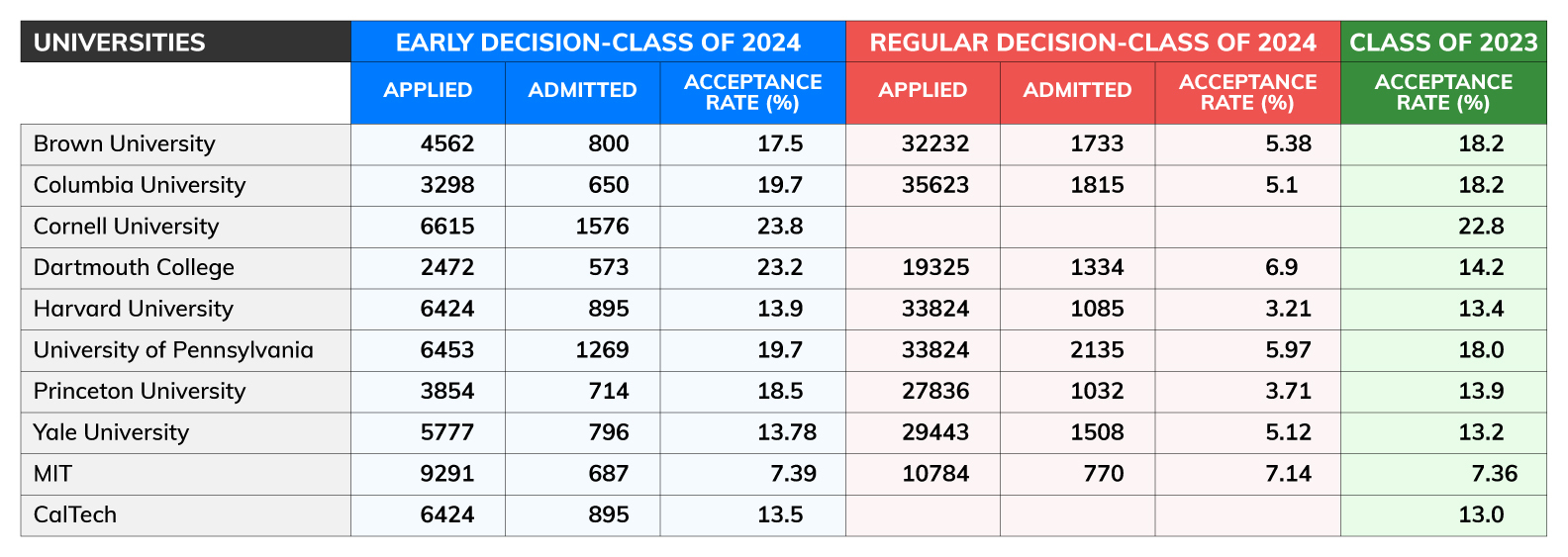
The US universities’ Early Application Notification Program consists of Early Decision (ED) and Early Action (EA), including variations of both. Applying ED1 allows applicants to indicate their commitment to join a certain college and benefit from the fact that acceptance rates are often higher for the early decision round. A college may offer either ED or EA or at times, both. The deadline tends to be Nov 1 for most colleges and mid-October for a few, with admission decisions typically released in Mid-Dec or by early Jan.
The Early Decision application is non-exclusive but binding. This means that with your one ED choice, you can apply to other colleges under the Early Action or Regular plans, but if you are accepted through Early Decision, you are committed to attend that school and withdraw the other applications you may have submitted. You may not apply to more than one college under an Early Decision plan. If rejected, the applicant may not apply again to the same college that year.
Students can apply to any number of Early Action colleges, irrespective of whether an ED application has been submitted or not. EA is not restrictive or binding, and offers the advantage of a quicker admissions decision.
Restricted Early Action, is a restrictive but non-binding early application plan which prevents a student from applying to any other college in the early round. There may be provisions allowing applications to public universities- based on the REA policies defined by the concerned college. If accepted, the student does not have to commit to the offer and is free to explore or choose other options.
Some colleges also offer ED II which can be availed by a student during the second round of applications - the ED II deadline falls in the first week of January around the Regular Decision deadlines, and students receive a binding decision by February. This may be a good choice for those who were rejected or deferred from another university under ED I or those who didn't take the SAT or ACT in time to meet the ED I deadline or who initially were not ready to commit to a certain school. Regular Decision becomes much more competitive for every college and ED II programs generally have a higher acceptance rate. The Ivy League and other top colleges and public universities do not offer ED II.
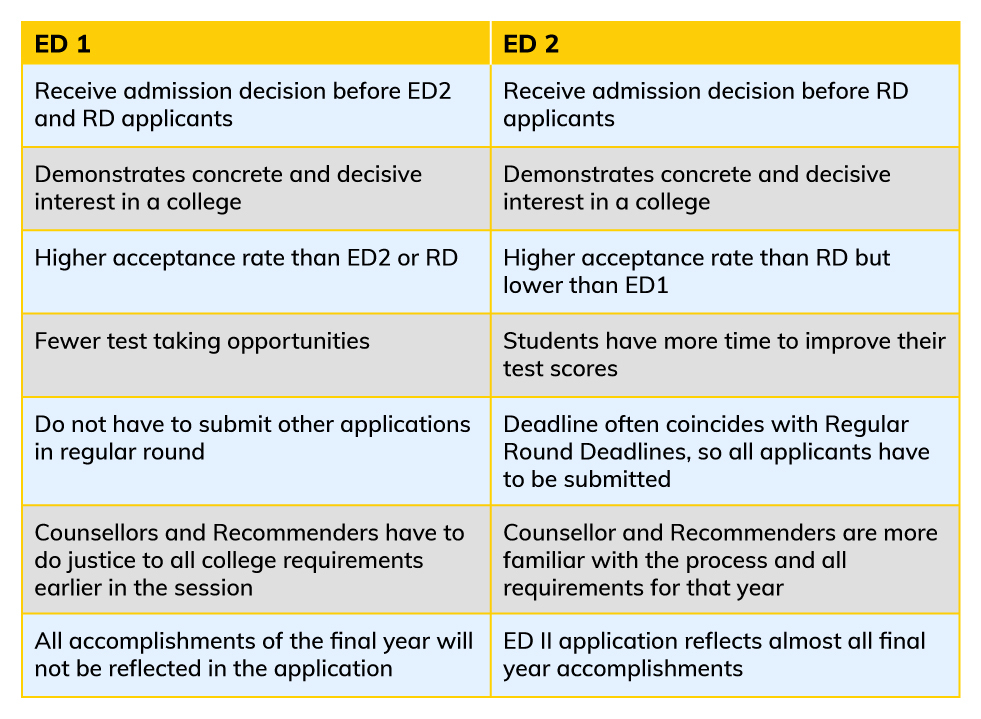
Qualified ED applicants can sometimes gain an advantage because they are expressing the strongest possible interest in the university. The acceptance rate for most universities is higher in the ED round as compared to RD.
A downside to applying ED is the inability to compare financial aid packages from multiple colleges. You can request to be released from the agreement if they cannot meet the financial need demonstrated in your application.
Schools will generally look at an applicant's first-quarter grades if provided, but not all schools require them. Incoming college students shouldn't let their senior year grades drop.
Generally, yes – but that may indicate to colleges that an applicant isn't as interested anymore, which may decrease the odds of being accepted via the regular decision.
Getting deferred, as opposed to accepted or rejected, means a school is still interested in the applicant, and will review their application again alongside Regular Applications. Generally, getting deferred means admissions officers need more information, such as fall semester grades and overall progress, before reaching a final decision.
Although rare, applicants should only back out if they can't afford the tuition, either because the financial aid package isn't sufficient or their financial situation has changed. Documentation may also be required as proof.
Students have to provide standardized test scores at an earlier date than if you were applying RD or ED II, which means there are fewer opportunities to retake Standardized Tests if not satisfied with initial scores.